The post ShotSpotter: There’s no lobbyist like an arms lobbyist appeared first on Seattle Privacy Coalition.
]]>Here’s the Intercept article in a nutshell:
- Despite claims to the contrary, ShotSpotter, which uses a network of microphones to pinpoint gunshots in covered areas, also records conversations going on in the vicinity. This is established fact, inasmuch as the recordings have been admitted as evidence in criminal trials.
- ShotSpotter’s wide deployment in over 90 US cities is powered by an aggressive lobbying campaign.
- DC lobbyist Ferguson Group, by targeting congressional delegations, has secured $7 million in federal funds to purchase ShotSpotter through Department of Justice.
- ShotSpotter also has hired lobbying firms Squire Patton Boggs, Raben Group, Greenberg Traurig, and Mercury Group Public Affairs to sell its products at the federal, state, and city levels, including coordination with police unions.
- Having laid the federal funding groundwork, ShotSpotter guides potential customers
through the grant application process. - ShotSpotter cultivates revolving-door relationships with law-enforcement heavies. Senior Vice President David Chipman is a former senior official at the ATF and a former fellow to the International Association of Chiefs of Police, and New York Police Commissioner William J. Bratton did a stint as a board member before assuming his present position as one of ShotSpotter’s newest and biggest customers. (Fortunately for the American Way, he recused himself from that purchasing decision.)
The article also spotlights the silly claims by company executives that ShotSpotter is not a listening device. As one helpfully explains, “It’s an acoustic sensor. It’s not a microphone,” which you can file under Distinction Without A Difference. And, as usual, ShotSpotter can’t keep its story straight. Our Oakland friend @marymad contributes this capture from the ShotSpotter Web site:
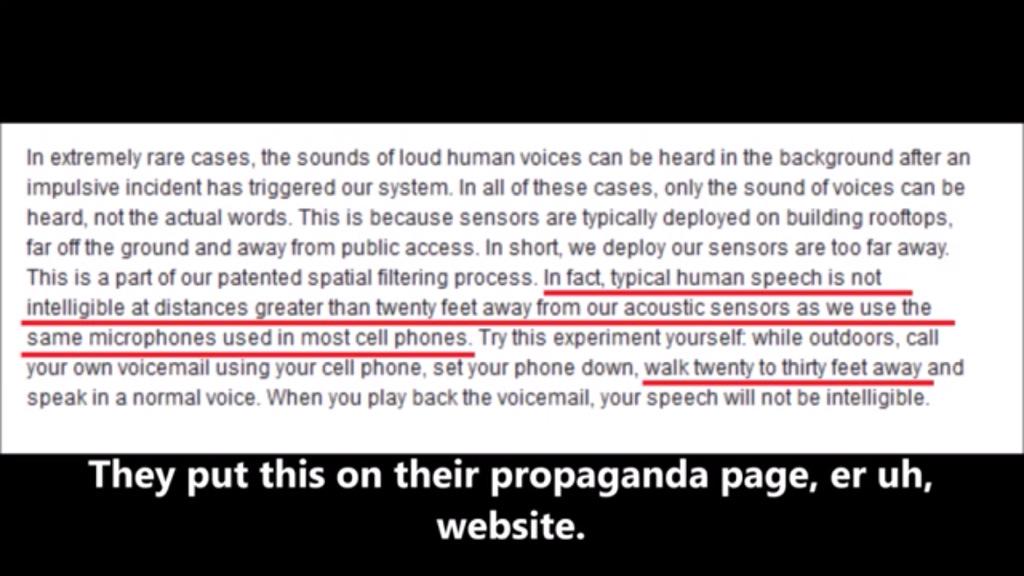
Just like a cell phone, eh? That explains why the 20-30 foot limit is nonsense, too. Cell phone users know that speaker-phone mode picks up anything loud enough to be picked up, regardless of distance. A conversation 100 feet away on a quiet street? No problem.
The Intercept piece concludes with this alarming assessment of the privacy issues presented by ShotSpotter’s audio surveillance:
ShotSpotter’s privacy policy claims this audio is “erased and overwritten” and “lost permanently” if its system does not sense a gunshot. However, even if this is true, the policy also states that ShotSpotter has detected and recorded “3 million incidents” over the past ten years. This also indicates the sensors report a staggering level of false alarms, and that the company has permanently recorded 18 million seconds — in other words, 5,000 hours or approximately seven months — of audio. According to a promotional document emailed to Miami city officials by ShotSpotter’s sales team, the technology allows end users to retain this audio online for two years and offline for another five.
The lessons here are not new:
- ShotSpotter is a questionable use of money, a technical quick-fix that does little for public safety and nothing for the underlying causers of crime.
- The company is a snake-oil merchant that constantly makes claims that defy scientific logic.
- The ShotSpotter lobbying machine is a public menace.
We support the plan by Seattle City Council to closely review the money provisionally allocated to purchase ShotSpotter.
The post ShotSpotter: There’s no lobbyist like an arms lobbyist appeared first on Seattle Privacy Coalition.
]]>The post In search of privacy advocacy from underrepresented communities appeared first on Seattle Privacy Coalition.
]]>Below is an email sent to a Seattle Police Department program manager regarding the the Muslim, Sikh and Arab Advisory Council to the Seattle Police Department on November 19th, 2014. The program manager, Maggie Olsen, promptly replied stating that my email had been forwarded to the Commander of the Community Outreach Section, Captain John Hayes. Jan and I have not yet received a reply.
Hello Maggie,

My name is Christopher Sheats, a concerned citizen of Seattle and a volunteer for the Seattle Privacy Coalition (SPC) (seattleprivacy.org).
My colleague Jan is CC'd, she is the SPC director. I'm writing with regard to the Muslim, Sikh and Arab (MSA) Advisory Council to the Seattle Police Department.

This email may be better directed to Detective Yanal Vwich, or possibly Chief Kathleen O'Toole. I attended my first MSA meeting on October 2nd, 2014. I advertised that the Citizens Technology and Telecommunications Advisory Board (CTTAB) was planning a privacy symposium to focus on the privacy impact to vulnerable populations in Seattle. The privacy symposium is supposed to happen next year, but I am not yet sure about details.

I also want Detective Yanal Vwich and the MSA to be aware that the City of Seattle is establishing a special, and likely permanent, privacy advisory board for the city. For more information about the new privacy
board:

CITY OF SEATTLE LAUNCHES DIGITAL PRIVACY INITIATIVE http://murray.seattle.gov/city-of-seattle-launches-digital-privacy-initiative/

Seattle Takes the Lead in Nationwide Surveillance vs. Privacy Debate https://www.seattleprivacy.org/press-release-response-to-seattle-privacy-initiative/

Composition of City’s Privacy Advisory Board (written by Jan) https://www.seattleprivacy.org/composition-of-citys-privacy-advisory-board/

I have several questions, please help where possible.

Q1- It appears that MSA and the East African Advisory Council's have been combined and that their meeting schedule has been severely reduced.
Why is that?

Q2- Given the privacy and trust implications of these vulnerable populations, I was surprised to learn that these meetings were being held at a government facility. I know that this has a negative impact on attendance. Why can't it be changed to a community center, with more access to bus routes?

NSA Surveillance Chilling Effects: HRW and ACLU Gather More Evidence https://www.eff.org/deeplinks/2014/07/nsa-surveillance-chilling-effects

Q3- Would't it be prudent to have a member of the Muslim community to be directly involved with the Seattle Privacy Advisory Board?

Latest Snowden Leaks: FBI Targeted Muslim-American Lawyers http://www.wired.com/2014/07/snowden-leaks/

One of the attendees bluntly accused that the FBI was spying on people in his community. The FBI attendee blatantly lied in response--given the Snowden revelations that go into specific proof that says otherwise. The Seattle City Council, the Seattle Police Department, local FBI offices, and the City's IT Dept all share the responsibility in gaining trust though cooperation and privacy enhancements.

Having gone to just one MSA meeting, I was almost overwhelmed with the amount of distrust between attending members of vulnerable populations and the various US Gov attendees. As an empathetic white male, it was uncomfortable.

On behalf of the Seattle Privacy Coalition, I would like to assist wherever possible to help bridge this divide, regarding trust through privacy. Please share the following information to the respective Advisory Councils where appropriate. It would also be great to get members of MSA involved with our citizen group (Seattle Privacy Coalition) for greater diversity:

Send an empty email to the following address to be put on our announce
list:
[email protected]

Seattle Privacy Coalition can be contacted directly:
[email protected]

I can be contacted directly, and I have a public PGP key available:
[email protected]
7DFF 4EE5 1C63 9060 C9C9
A48A BEAF 1420 523A EB46

If any of you would like help setting up your own PGP key-pair so that people can securely contact you, or an alternative secure chat application, please let me know.

Lastly, with your permission, I'd like to publish any or all responses to our blog, SeattlePrivacy.org, so that the public can be further educated about these ongoing issues.

Cheers

Christopher Sheats
citizen
The post In search of privacy advocacy from underrepresented communities appeared first on Seattle Privacy Coalition.
]]>The post “If not for Seattle, this history would be different” appeared first on Seattle Privacy Coalition.
]]>A few days before the Seattle City Council announced its precedent-setting privacy initiative, the year’s most anticipated documentary, Citizenfour, opened at the Uptown SIFF Cinema. Laura Poitras’s third film about the post-9/11 American security state tells the story of Edward Snowden, the NSA whistle-blower who made “dragnet surveillance” a household term.
Seattle’s step toward privacy and accountability was well-covered in the local press and also made the leap to a couple of governance trade journals. Seattle Privacy made sure that Laura Poitras herself knew what had happened here at the same time that her film was drawing capacity crowds. She sent us congratulations:
It is fitting that Seattle is first to respond – it is the home of NSA
PRISM partners such as Microsoft, as well a strong community of people
building alternatives to dragnet surveillance. These alternatives, as
well as informing and engaging with the people of Seattle, are a step
toward regaining meaningful democratic oversight relating to security
and privacy in our country.
If not for Seattle, this history would be different.
When the Seattle Privacy Coalition came together in early 2013, the city’s political establishment issued us the tin-foil hats reserved for people who worry about government surveillance. The disgraced, federally supervised Seattle Police Department was so used to getting its way in technology matters that it shrugged off negative public reaction to the “port security” camera network. In talks with city officials, we provoked eye-rolls and knowing smirks by suggesting that the city should pass up federal grant money that paid for boondoggles such as police drones. [Note: See the update at the end of this post. It ain’t over.]
After Snowden, the complacency was gone. Little has changed at the national or state levels — the security agencies still run Congress and the White House, Boeing still dictates to Olympia. But locally, there is movement. DHS-funded spying and cops in tanks have become issues with names: Oakland, Ferguson. The city establishment’s dread of controversy now works in favor of privacy advocates. The security lobby will have a hard time influencing every petty municipality the way it influences the federal government.
An evolving model for political action emerges from Citizenfour. In a world where democracy and the press have ceased to function at the highest levels, we watch lone individuals making fateful choices grounded in their private experience. These precise moments of integrity contrast with farcically mediated global contexts: archival footage of NSA Director Keith Alexander and National Security Director James Clapper telling extravagant lies to Congress; a frantic scrum of boom-bearing reporters around Glenn Greenwald and his partner (and taking care to edit themselves out of the film they will broadcast); or the recurring apparition of Wolf Blitzer playing Wolf Blitzer. Always there is a strong implicit case for what it real and what is not, and where personal agency lies.
“There’ll be the breaking of the ancient western code / Your private life will suddenly explode.” — Leonard Cohen
Poitras, not Snowden, is the first example of this in Citizenfour. Out of the blue, Snowden sends her an encrypted email message, an event recreated on-screen as white text unspooling in the black void of a Linux computer terminal. Disembodied in this weirdly intimate environment, an as yet anonymous Snowden tells her he is a spy, that he has classified disclosures to make, that there is great danger, and that their joint government adversary can attempt one trillion password cracks per second. Her private decision to accept this mysterious challenge leads to the events of the movie. When she later asks “Citizenfour” why he had chosen her, He tells her, “You chose yourself.”
Poitras next tells the story of NSA veteran William Binney. After the end of the Cold War, he developed systems to automate the collection and analysis of telecommunications metadata. Originally, the targets were foreign, but shortly after 9/11, NSA turned Binney’s work into the basis of its new program of blanket domestic surveillance. His internal protests against NSA’s lawless, ineffective, and wasteful policies went nowhere, and he soon left the agency. After being raided at gun-point in 2007 during an FBI leak investigation (in which he was later cleared), Binney gained prominence as one of the most outspoken NSA whistle-blowers prior to Snowden.
The misguided raid on Binney was provoked in part by the revelations of Mark Klein, who is not actually in the movie, though we do see a hearing from one the lawsuits that resulted. Klein was a technician for AT&T who discovered that Room 641a at 611 Folsom Street in San Francisco was an NSA diversion site for all of AT&T’s Internet and telephone traffic. Appalled by what amounted to a tap on the entire Internet, Klein took his story to the Los Angeles Times, which refused (under government pressure) to print it. He next took it to the New York Times, which also bowed to government pressure for a year before finally publishing it in 2005.
Seattle Privacy’s co-founder Jacob Appelbaum turns up twice in the film, once before and once after his NSA reporting forced him into Berlin exile. In one segment, he presses an Occupy Wall Street audience to consider whether they have been personally under surveillance, and lists ways it could have happened — not just by means of telephones, email, and the Web, but also credit cards, travel passes, etc. He calls them canaries in a coal mine who are experiencing what everybody will experience in the near future. (As Jacob likes to say, “My present is your future,” though he now thinks the future has pretty much arrived for everyone.) The personal experience entails the universal problem, and is the key to fighting it.
We also meet Ladar Levison, the [former] proprietor of the secure email service Lavabit. Its most famous customer: Edward Snowden. Levison built an encrypted mail service that collected no information on its users, and thus had nothing to give law enforcement even when subpoenaed. Unable to identify Snowden’s correspondents in the usual way by seizing metadata, the FBI told Levison to give up Lavabit’s master SSL encryption keys, which would allow them to uncloak the entire Lavabit customer base secretly in real time. Levison instead shut down his business rather than betray his customers’ privacy. Try to imagine that in a corporatized setting where profit is paramount and ethical concerns are actionable in civil court.
In bare outline, Snowden’s own story is that he gave up his prior life and risked life imprisonment (or worse) to expose the actions of NSA and its partners. Most will remember his principled if fatalistic rationale from the original June 2013 interview. In Citizenfour, Snowden’s anxiety and regret become palpable. He masters his fear and steps through the hotel room door into what may be the waiting arms of a hostile government. Though Snowden repeatedly downplays his role in leaking the documents — “I’m not the story” — his choice is the story.
At Seattle Privacy, we hope to change how citizens are treated by their local government and by the police. The recent good news notwithstanding, we will continue to push the City Council to follow through on its stated intentions. We don’t want the promised oversight structure to end up a dead letter like Ordinance 124142, another privacy “first” that was passed 18 months ago and never enforced. At stake is a role for Seattle as a national model of awakened democratic government. It took bold individuals to expose the corrupt surveillance state, and it will take a bold community to prove Laura Poitras right: “If not for Seattle, this history would be different.”
Update:
Even as I wrote and published this, the City Council threatened to reverted business-as-usual by planning a budget hearing for a ShotSpotter-type system. For information about the city’s past flirtation with outdoor audio surveillance (and some sleazy video of Seattle politics at its worst) see our ShotSpotter fact sheet. Rest assured we will communicate to our leaders what we think of their renewed interest in ShotSpotter.
The post “If not for Seattle, this history would be different” appeared first on Seattle Privacy Coalition.
]]>The post Seattle Takes the Lead in Nationwide Surveillance vs. Privacy Debate appeared first on Seattle Privacy Coalition.
]]>This morning, Mayor Ed Murray and Seattle City Council members Mike O’Brien and Bruce Harrell boldly announced a new initiative[1] to begin to address the erosion of privacy in our society. Seattle is the first city in the nation to take such a proactive and farsighted step. The initiative will begin with a systematic review of the potential effects on personal privacy of all city programs and policies.
“This move will save Seattle taxpayers money by limiting spending on ideas like surveillance cameras or drones that later need to be scrapped.” -Adam Shostack
The Seattle privacy initiative comes two years after disclosures about Seattle Police Department’s acquisition of surveillance drones[2] and installation of a public surveillance camera network[3] drew public concern and protest. This debate merged with concerns about spying on political activists, unchecked use of facial-recognition technology, locational surveillance via automated license plate readers, and data sharing with private entities along with state and federal agencies.
The Seattle Privacy Coalition applauds Seattle’s leaders and legislators for their bold move to grapple with the difficult and vexing issue of protecting privacy while embracing technological innovation, and for their commitment to expanding civic involvement and bringing more voices to the table.[4]
“We hope that this effort will serve as a model for other municipal governments, and give heart to grassroots privacy advocates everywhere,” said Jan Bultmann, co-founder of SPC. “This development shows that even if our federal government is too paralyzed and beholden to corporate interests to act, we don’t have to sit back and watch our right to privacy evaporate. We can work with local governments who can still hear and respond to our voices.”
“This move by our city’s leadership is exciting,” said Christopher Sheats, Seattle resident and political activist. “It demonstrates that they’re listening to those whom they represent, and that community input is valued here in Seattle. The proposal to further implant privacy-strengthening processes in our city’s government is a refreshing reminder that civil liberties can be protected regardless of advancements in technology.”
“I am happy to see Seattle recognizing the importance of privacy to our citizens and residents,” said Adam Shostack, Seattle resident and author of Threat Modeling: Designing for Security. This move will save Seattle taxpayers money by limiting spending on ideas like surveillance cameras or drones that later need to be scrapped.”
“Meaningful transparency and accountability requires regular people’s fully informed civic involvement. I’m glad to see that the city of Seattle has heard the call and is committing itself to democratic action. This moment in Seattle is made possible because of the sacrifice and courage of the whistleblower Edward Snowden. It is exactly these kinds of changes all across America that he worked to create,” said Jacob Appelbaum, privacy journalist and co-founder of of Seattle Privacy Coalition.
THE PLAN IN BRIEF
2014
- Convene team of representatives from city departments to oversee creation and implementation of the privacy program.
- Appoint a Privacy Advisory Committee of academic and community leaders to develop privacy principles and advise the government team.
2015
- Develop privacy guidance documents to insure departmental awareness and compliance.
- Assess the current state of city compliance with the new policies.
- Remediate gaps in compliance.
- Establish an ongoing privacy oversight structure.
Seattle Privacy Coalition is a group of current and former Seattle residents that formed in April 2013 over a shared interest in transparency, accountability, and accuracy about the current state of privacy, security, and related issues. Our first project was to explore, document, and provide oversight relating to the Seattle Police Department’s surveillance camera network. Our mission is to urge and empower the City of Seattle to take advantage of Seattle’s leadership in technology and commitment to civil rights to lead the United States to restore and protect all people’s right to privacy.
[1] http://clerk.seattle.gov/~public/meetingrecords/2014/cbriefing20141103_3a.pdf
[2] http://westseattleblog.com/category/seattle-police-surveillance-cameras/
[3] http://westseattleblog.com/category/seattle-police-surveillance-cameras/
[4] https://www.seattleprivacy.org/mission/
The post Seattle Takes the Lead in Nationwide Surveillance vs. Privacy Debate appeared first on Seattle Privacy Coalition.
]]>The post We get excellent coverage in the Seattle Times appeared first on Seattle Privacy Coalition.
]]>The post We get excellent coverage in the Seattle Times appeared first on Seattle Privacy Coalition.
]]>The post Seattle’s operating surveillance ordinance still needs fixing appeared first on Seattle Privacy Coalition.
]]>I recently noted that one of the wireless mesh nodes was transmitting, in contradiction of the City’s repeated assurances that the network was “turned off,” while I was attending a protest outside the King County courthouse in City Hall Park near 3rd Ave and Yesler Way. My post to Twitter caught the attention of the Seattle Police Department, who promptly shut off the node and posted a blog entry and tweeted about it. The following tweets appeared on Twitter that day, with much more commentary on the original post (which you can see if you click on the date stamp below.)
#SEAspy #MeshNet node is transmitting on “3rd&Yesler” and “TEST-WAP” SSIDs. @SeattlePrivacy @SeattlePD #rootsup2014 pic.twitter.com/Z0gHtp8Rrp
— lee⭐c (@sleepylemur) July 11, 2014
What we know about our node. http://t.co/PgeQFRqpkS #nodecomment
— Seattle Police Dept. (@SeattlePD) July 12, 2014
Seattle Police officer Sean Whitcomb’s reply on the SPD blotter makes a misleading claim, that “The rogue node, while producing a visible signal, was not being operated.” This isn’t only misleading because radio waves are invisible. They’re also not visible because the Service Set IDentifier (SSID or “network name”) of these mesh nodes gives no indication that they’re operated by the police department. It’s not the sort of thing that a nontechnical person would notice, even if they saw it listed on a computer or mobile device when they were trying to find a wireless network. It’s also misleading to claim that the node was “not being operated”.
The device may not have been switched on intentionally, it may not have seen any active traffic from SPD vehicles or those of other city departments while it was powered on and transmitting, but a claim that it wasn’t operating is the same category of the “non-operational” SPD cameras installed throughout the city. The glowing blue light indicates that power is applied to the cameras, just as the blinking orange and green lights indicate that mesh network nodes have power and some sort of activity. According to the Seattle Police’s definition of “operating”, these networked surveillance cameras aren’t “in use” because the digital video recording system to which they’re attached isn’t capturing any of their video feeds.
@sleepylemur @SeattleCouncil @SeattlePrivacy Lee, consider this “confirmed”. The cameras are not in use. sw — Seattle Police Dept. (@SeattlePD) September 11, 2013
However, as Mayor Murray opined in an interview on the matter, the cameras and their mesh network could be switched on if the City decided they were needed for some sort of emergency (the Boston Marathon bombing was mentioned, but any emergency could do). Now, this mayor may have no intention of using these cameras and Seattle’s current police force might not intend to use their mesh network to monitor the movements of every active WiFi and Bluetooth device in the city (see The Stranger’s article You Are A Rogue Device), but we’re a country of laws, not of men.
Seattle should revise its ordinance regarding the installation and use of surveillance equipment. We made recommendations to the city council regarding Ordinance 124142 in March and this matter still needs to be addressed.
The post Seattle’s operating surveillance ordinance still needs fixing appeared first on Seattle Privacy Coalition.
]]>The post The sort of thing we are curious about… appeared first on Seattle Privacy Coalition.
]]>In bland technical language, we learn that the network has the following capabilities.
- It can limit logins to a list of approved users stored in a database.
- It can identify potential users based on username/password or hardware device IDs.
- It will keep detailed logs (time, duration, identity, etc.) of client connections.
However, these details raise questions that still have not been answered by the Seattle Police Department or any other city office.
- What happens if a random passerby with a laptop or cell phone attempts to “associate” with a city access point? The answer to this could have privacy and security implications for both parties.
- Wi-Fi devices broadcast uniquely identifiable radio beacons; does the city equipment record these beacons, or can it be configured to do so? Authorities in Chicago are planning just such a capability in a potentially intrusive Big Data collection scheme.
- How long will logs be kept, and who will have access to them? Will they be subject to public records requests?
These are questions that should have been asked and publicly debated at early stages of the planning process. They also quickly become issues of general policy: If data is collected, it will be used by any legal or illegal branch of government whose agents can pick up a phone. To protect privacy, don’t collect sensitive information in the first place.
Below is a link to the source documents, courtesy of Tacoma-based Infowars reporter Mikael Thalen, who discovered them on the Seattle.gov Web site:
Or download the document.
The post The sort of thing we are curious about… appeared first on Seattle Privacy Coalition.
]]>The post Shelved Seattle Police drones highlight transparency problems with surveillance equipment appeared first on Seattle Privacy Coalition.
]]>Brief refresher: In early 2012, three days after then-mayoral-hopeful Bruce Harrell of Seattle City Council introduced a bill to regulate the use of drones by Seattle Police Department, then-mayor Mike McGinn one-upped his opponent by abruptly announcing an end to the drone program. McGinn also declared that the devices would be sent back to the vendor from which they were purchased.
This was a win for the public–we never asked our police to purchase flying surveillance cameras in the first place–and we celebrated it as such. But to those who were paying close enough attention, McGinn’s decree looked like political posturing.
Surveillance technology advances rapidly. The fact that SPD’s 2010-era drones, with their 15-minute battery life and inability to fly in the rain, are sitting on a shelf here in Seattle gathering dust doesn’t worry us.
We are more concerned about the continued lack of transparency in how surveillance equipment is acquired and deployed (and disabled, or not disabled), and the lack of meaningful oversight of the police department, and about the fact that our police continue to use U.S. Department Homeland Security money to purchase equipment the public doesn’t trust them to use in a constitutional manner.
Our Mayor and City Council need advice from technologists and privacy advocates to fend off the ever-encroaching surveillance state at the local level. Until we formalize a system for providing elected officials with the information they need to make good decisions, they will continue to be blind-sided by SPD’s use of their homeland security slush fund for purchases of equipment used to treat everyone as a potential suspect.
Other coverage:
The Seattle Police Dept Said It Would Get Rid of Its Drones. It Hasn’t.
by Shawn Musgrave
March 25, 2014
Seattle Police Secretly Keep Drones Despite Promise
by Mikael Thalen
March 26, 2014
Seattle Police Still Have Drones
by Ansel Hertz
March 26, 2014
The post Shelved Seattle Police drones highlight transparency problems with surveillance equipment appeared first on Seattle Privacy Coalition.
]]>The post Video: City Council authorize federal funding for facial recognition and fusion center appeared first on Seattle Privacy Coalition.
]]>At the 2:00 p.m. March 10, 2014, Seattle City Council meeting of the full council (agenda), public comment was received from five people regarding Council Bill 118043, which authorized federal funding for facial recognition software and the Washington State fusion center. Each person spoke in opposition to passage of the bill. Because public comment was, as is typical at City Council meetings, limited to 20 minutes, some people who wished to speak were not allowed to do so. After public comment, council members discussed the bill, then voted 7-1 to pass the bill, with Kshama Sawant casting the lone vote in opposition.
A complete video archive of the meeting is available from Seattle Channel for streaming and download. In attendance at the meeting were (in order from left to right as visible in the video) council members Sally Bagshaw, Bruce Harrell, Sally Clark, Tom Rasmussen, Tim Burgess, Jean Godden, Mike O’Brien, and Kshama Sawant.
Council Bill 118043 authorizes acceptance of a financial grant from U.S. Department of Homeland Security under the Urban Areas Security Initiative program, including about $1.2 million for Seattle Police Department, and ratifies and confirms any act made pursuant to the authority of the ordinance taken prior to the effective date of the ordinance. Intended uses of the DHS funding that have been disclosed to the public include purchase of facial recognition software for use by Seattle Police Department staff and further funding of the regional fusion center.
We are unaware of any way to link directly to a point in time in a video hosted by Seattle Channel, so we cached a portion of the video archive of yesterday’s meeting elsewhere.
Following is an index to relevant portions of that video:
- 06:42 Public comment: Scott Shock
- 08:41 Public comment: Lee Colleton
- 14:27 Public comment: Christopher Sheats
- 17:11 Public comment: David Robinson
- 19:19 Public comment: Phil Mocek
- 23:19 Introduction of item #1: Council Bill 118043
- 24:06 Councilmember Harrell
- 29:47 Councilmember Bagshaw
- 31:15 Councilmember Sawant
- 34:28 Councilmember Harrell
- 36:40 Councilmember Clark
- 40:55 Councilmember O’Brien
- 42:12 Councilmember Burgess
- 42:23 Rollcall vote
The post Video: City Council authorize federal funding for facial recognition and fusion center appeared first on Seattle Privacy Coalition.
]]>The post How to fix Seattle’s operating surveillance ordinance appeared first on Seattle Privacy Coalition.
]]>We call on City Council to make the following improvements to Ordinance 124142, also known as “the operating surveillance equipment” ordinance, before the end of calendar year 2014.
- Ordinance 124142 should be amended to regulate all government agencies operating in Seattle, not merely departments in the city of Seattle.
- Ordinance 124142 should be amended to tighten or entirely remove the exigent circumstances loophole. There are rarely if ever exigent circumstances involved in the purchase of a large-scale strategic surveillance system. If such exigent circumstances do arise, all such exigent circumstances, equipment purchases, budgets, ongoing relationships, training, and outcomes should be reviewed by City Council.
- Instead of excluding certain existing data-gathering equipment, Ordinance 124142 should specifically ensure that digital in-car video systems (“dash cams”), automated license plate reader (ALPR) systems, “port security” cameras, and other such data-gathering systems will be reviewed. The ALPR system is the most important of these to receive review, as the use of it amounts to wide-area surveillance of everyone–not simply those people who are suspected of having committed crimes. Systems that gather data on behalf of SDOT, SCL, and SPU should also be covered by the ordinance.
- Ordinance 124142 should also require all government agencies operating in Seattle to compile and regularly publish statistical information about their use of equipment regulated by this ordinance with at least the level of detail that is currently provided in the annual Wiretap Report publication of the Administrative Office of the United States Courts.
- All protocols for use of surveillance equipment must be public.
- Any and all aspects–even secret ones–of surveillance performed by or commissioned by government agencies in Seattle must include automatic sunset provisions.
- All property used for communications interception wire rooms or other surveillance (e.g., rentals of houses, vans, etc.) must be accounted for in a budget. When properties are no longer used for such purpose, their addresses must be disclosed. Similarly, the surveillance-related purpose of other expenses must be disclosed after the necessarily-secret nature of their use concludes.
- The ongoing budget and expenses for surveillance activity funded by City of Seattle must be public during this entire time so that we, the people, can review these expenses and recognize if such activity has spiraled out of control relative to other city priorities. The public must have the ability to determine if a general area has been under surveillance.
- All non-SPD contact (eg: FBI, TSA, ICE, SS, any part of DHS, etc) that request assistance, clearance, or notification of surveillance should be logged. Thus, if the FBI is performing a raid of say, your house, the local police don’t accidentally think it is a (different kind of) crime in progress. This already happens, the key is that the log should be audited and not just a matter of coordination.A requirement that any surveillance operations within Seattle must be logged with the Seattle police – thus, the FBI would be required to notify the SPD, even if only for their spying activity.
- All legal statutes must be cited *during* collection as to why the collection was undertaken in the first place.
- All electronic surveillance must be logged, including location, equipment type, legal justification and information on the officer(s) involved.
- All surveillance requests involving any non-SPD agency, company or private individual must be logged. For example, if SPD asks Google for data on Yoga Arts, that request must be logged.
- The ordinance should specify that all surveillance data or metadata is only for use with the SPD and is not for data sharing with WSIN, the State of Washington, any Federal agency or any other agency, company, or person without a specific court order.
- A log of all contact made with those under surveillance – that is – each time a person is under surveillance and the collection ends, the person should be notified and it should be logged. A lack of notification should also be logged. This information should become public record automatically and absolutely handed over during a Privacy Act Request (PAR) by the target of surveillance.
- If there was a sneak-and-peak warrantless search (eg: PATRIOT Act, Section 215) or a search conducted with a sealed warrant, this must be logged specifically as such. It should be logged with a third party that is not the SPD. We’re open to suggestions as to which party is a good one. It seems that the Mayor’s office is probably a reasonable first choice.
- If during the course of a surveillance operation, a person is in harm’s way and disclosure *could* expose the surveillance operation, the surveillance team has a *duty* to put public safety before secrecy of the specific operation. This is already the case with good Samaritan laws in most states – when we see a person in trouble, we are required by law to help. For better or worse, it should apply to law enforcement and intelligence agencies, even if it would otherwise harm the secrecy of the operation.
Enforcement
- Ordinance 124142 must be enforced, and penalties for violation must be specified.
The post How to fix Seattle’s operating surveillance ordinance appeared first on Seattle Privacy Coalition.
]]>